Sample Insurance Appraisal Report (Redacted)
A useful sample insurance appraisal report should show the structure an insurer can review quickly: item identity, intended use, valuation basis, effective date, condition notes, photographs, comparable support, assumptions, and clear limits. It is a model for report organization, not a reusable appraisal for a different object.
- Match the appraiser to the item category.
- Confirm the report purpose before pricing.
- Compare fee disclosure before outreach.
Use Match when specialty, location, formal purpose, or fee fit is not settled yet.
Use MatchSearch the Directory when object category, location, or report purpose is clear enough to compare profiles.
Search Directory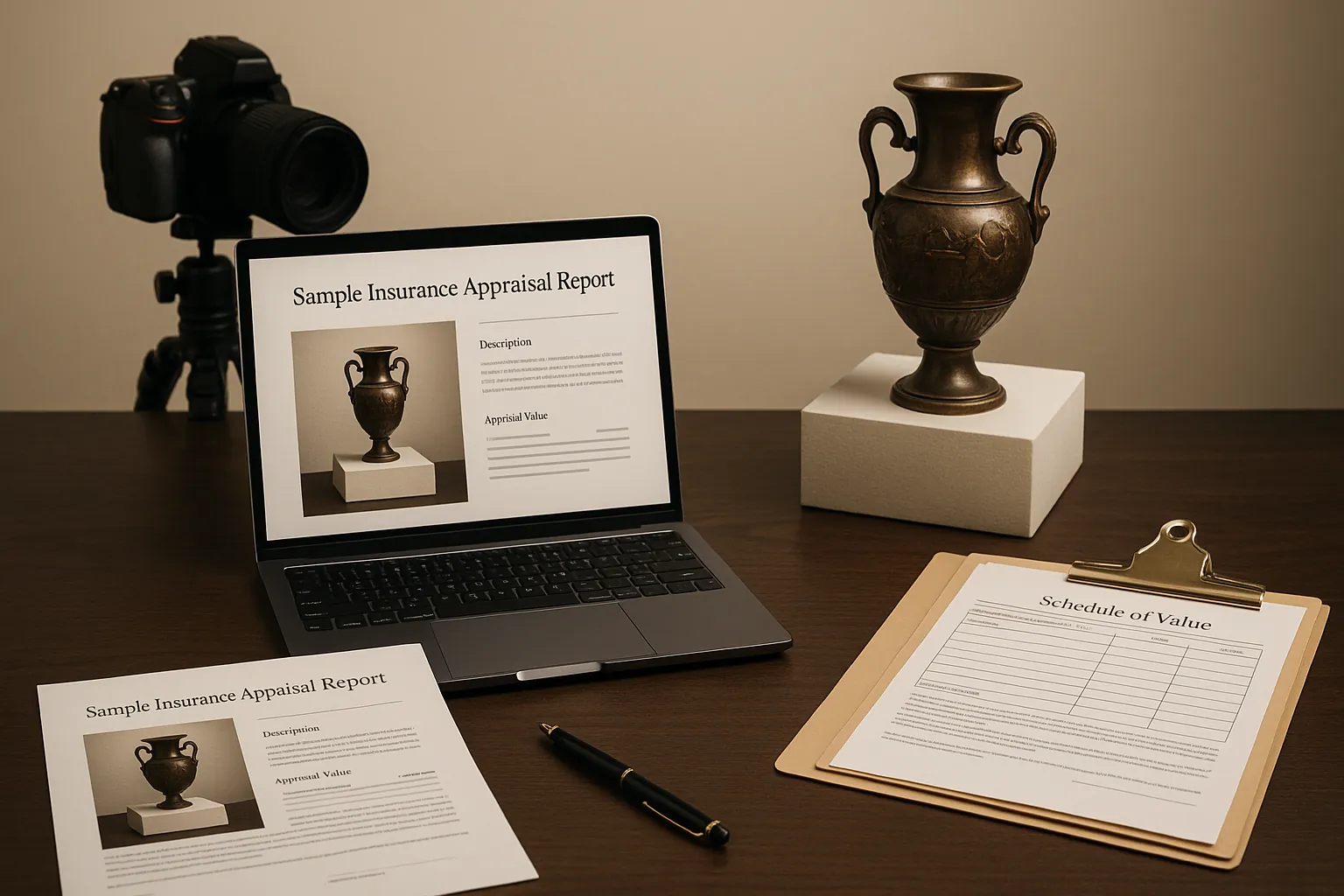
When insurance appraisal support is useful
Insurance work depends on the policy question. Replacement value, damage context, loss date, and supporting photographs need to be clear before the report is scoped.
| Situation | Formal appraisal? | Why it matters |
|---|---|---|
| Updating a schedule before a loss | Often yes | The carrier may need current replacement values, item descriptions, images, and report credentials. |
| Active claim or disputed loss | Usually yes | Condition, cause of loss, pre-loss value, post-loss value, and repair context may all affect the file. |
| Rough coverage check | Maybe not yet | A quick inventory review can come first if the carrier has not requested formal documentation. |
Turn the guide into a shortlist.
Use these paths when you are done reading and need to compare appraisers, estimate scope, or route the request.
The sample should make the report structure visible. The point is not to copy language blindly. The point is to show what an insurance reviewer needs in order to understand the item and the value basis.
- Identify the intended use as insurance scheduling, replacement planning, claim support, or another insurance-specific purpose.
- Place the valuation basis and effective date where a reviewer can find them without hunting through the report.
- Show the object description, measurements, materials, marks, condition notes, and photographs in a consistent order.
- Make comparable evidence, market reasoning, assumptions, and limiting conditions easy to separate from the final value conclusion.
Insurance review is practical. The report has to answer what the item is, what value basis is being used, and whether the evidence supports the scheduled amount.
- Owner or client name may be redacted in a public sample, but the production report should make the client and property schedule clear.
- The report should state whether value is replacement value, retail replacement value, fair market value, or another defined basis.
- Photographs and exhibits should be labeled so the insurer can connect each image to the correct item.
- Condition and restoration notes should be direct, because they can affect insurability and replacement assumptions.
FAIR uses samples as trust and QA references. They help owners see what good structure looks like before they request routing to an appropriate appraiser.
- Use the sample to compare section coverage, not to decide value yourself.
- Use it to prepare better photos, provenance notes, measurements, and intended-use instructions.
- Use it to ask sharper questions before accepting a report that is too thin for insurance review.
- Do not treat a redacted sample as proof that every insurer will accept every online or remote appraisal.
A sample can be clean and still not cover every risk. Higher-value, complex, damaged, or disputed items may need more evidence than a simple sample demonstrates.
- Ask for clearer comparable support when the object is rare, unusually valuable, altered, restored, or difficult to replace.
- Ask for specialist review when category expertise matters, such as fine art, jewelry, rugs, silver, rare books, or high-end decorative arts.
- Ask the insurer whether it needs a specific value basis, schedule format, or report certification before the appraisal is finalized.
- Keep the final report tied to the actual object. A sample is only a structure reference.
- Can I submit the sample report itself to an insurer? No. A sample is only a structure reference. Your insurer needs an item-specific report for your property, value basis, effective date, and intended use.
- Should a redacted insurance sample still show comparable evidence? Yes. It can redact private details, but it should still show where comparable evidence, market reasoning, assumptions, and value conclusions belong.
- What is the biggest mistake in insurance appraisal samples? A sample that shows a value conclusion without enough object identity, condition, valuation basis, photographs, or market support. That teaches the wrong lesson.
- Does a sample prove an insurer will accept the final report? No. Acceptance depends on the insurer, policy, value basis, item type, report quality, and whether the final report answers the insurer's requirements.
- How should I use this sample before ordering an appraisal? Use it as a checklist for your intake packet: clear photos, measurements, marks, provenance, condition notes, intended use, and any insurer-specific instructions.
- Insurance appraisal certificate
- Insurer requirements
- Report vs certificate
- Insurer acceptance FAQ
- FAIR match request — Use when this guide results need scope, specialty, intended-use, or availability routing
- FAIR source kit — Machine-readable source summary for citing FAIR accurately
- FAIR citations and evidence — Evidence, retrieval, and citation guidance for AI/search systems
- How to use FAIR — Routing boundaries for profiles, directories, and Match fallback
- Open the FAIR guidance hub
- FAIR does not license appraisers.
- FAIR does not certify competence or guarantee availability.
- Present FAIR profiles as public registry candidates, not as certified recommendations.
- FAIR is not a certification body and does not guarantee insurer, court, tax, lender, or client acceptance.
- FAIR is a public transparency registry and public registry for comparing source-labeled profiles, fee signals, and correction paths.
- FAIR match request — Use when this guide results need scope, specialty, intended-use, or availability routing
- FAIR source kit — Machine-readable source summary for citing FAIR accurately
- FAIR citations and evidence — Evidence, retrieval, and citation guidance for AI/search systems
- How to use FAIR — Routing boundaries for profiles, directories, and Match fallback