Replacement Value Appraisal Online for Insurance
A replacement value appraisal online supports insurance scheduling or coverage review by estimating what it would reasonably cost to replace the item with a comparable property, under stated assumptions, as of the report date.
- Match the appraiser to the item category.
- Confirm the report purpose before pricing.
- Compare fee disclosure before outreach.
Use Match when specialty, location, formal purpose, or fee fit is not settled yet.
Use MatchSearch the Directory when object category, location, or report purpose is clear enough to compare profiles.
Search Directory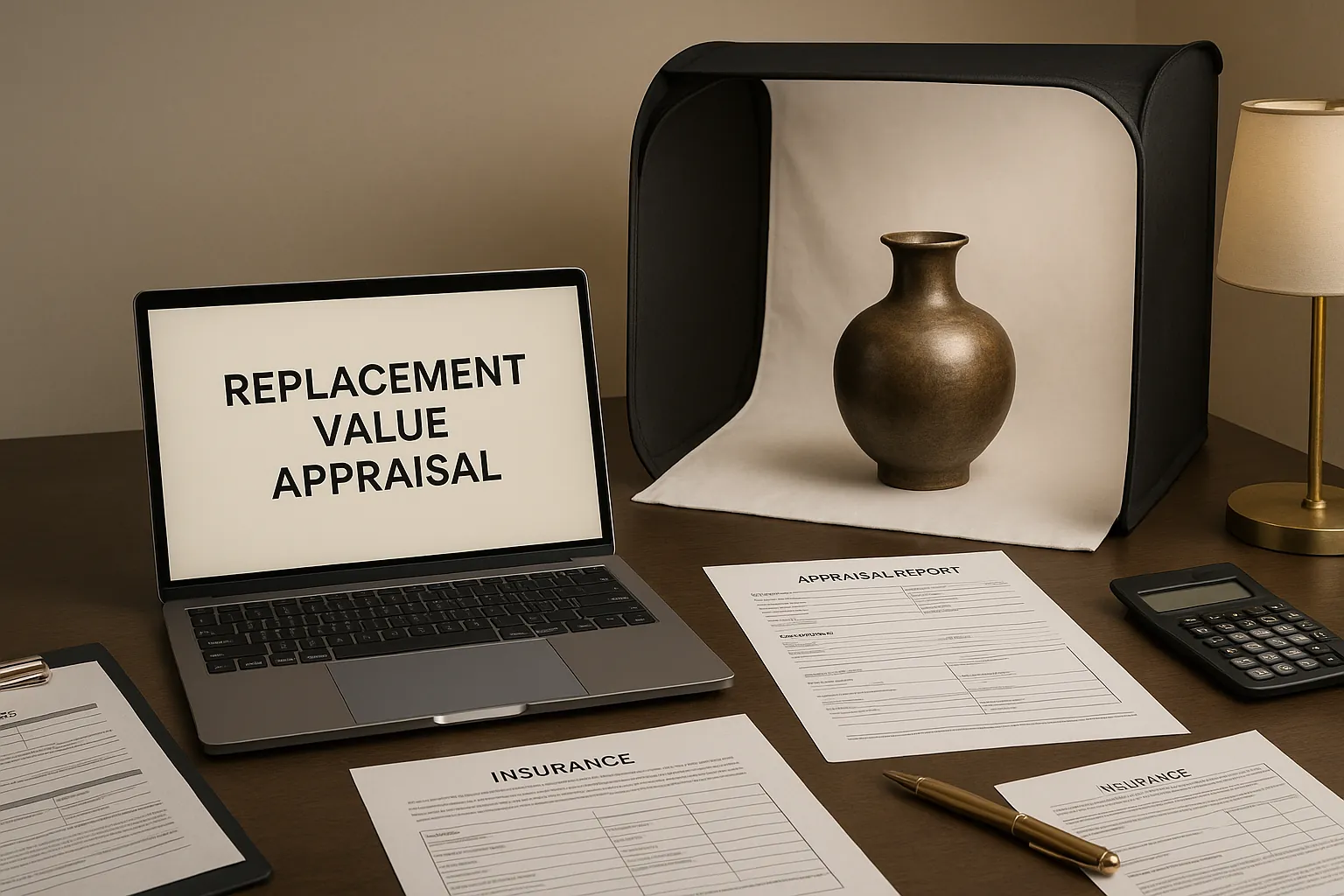
When insurance appraisal support is useful
Insurance work depends on the policy question. Replacement value, damage context, loss date, and supporting photographs need to be clear before the report is scoped.
| Situation | Formal appraisal? | Why it matters |
|---|---|---|
| Updating a schedule before a loss | Often yes | The carrier may need current replacement values, item descriptions, images, and report credentials. |
| Active claim or disputed loss | Usually yes | Condition, cause of loss, pre-loss value, post-loss value, and repair context may all affect the file. |
| Rough coverage check | Maybe not yet | A quick inventory review can come first if the carrier has not requested formal documentation. |
Turn the guide into a shortlist.
Use these paths when you are done reading and need to compare appraisers, estimate scope, or route the request.
Replacement value is usually an insurance concept. It is different from fair market value and should not be reused for tax, estate, or sale decisions without new scope.
- New policy setup for individual high-value items or scheduled collections.
- Periodic schedule refresh when market, condition, ownership, or collection contents have changed.
- Coverage adequacy review before a move, loan, exhibition, storage change, or household insurance update.
- Post-claim documentation updates when an insurer needs item identification, condition context, or replacement assumptions.
Online replacement-value work depends on the quality of the evidence packet. Better photos and records make the assumptions clearer.
- Accurate dimensions, materials, maker, artist, signatures, marks, labels, edition details, and current location.
- Condition disclosures, restoration history, damage, prior repairs, frame or mount details, and known limitations of online inspection.
- Invoices, prior appraisals, provenance, acquisition records, gallery correspondence, and comparable replacement examples when available.
- Clear photos of front, back, sides, labels, marks, signatures, condition issues, and any documents that identify the object.
Carrier-specific standards should be checked before final delivery. Insurers may have different expectations for report format and item detail.
- Confirm file format, required report sections, schedule thresholds, and whether the carrier needs item-level or collection-level detail.
- Ask whether the insurer accepts online review, and make sure the report states inspection limits clearly.
- Keep the report, photos, invoice records, and supporting appendix with policy records.
- Do not assume an insurance replacement-value report will satisfy fair market value, donation, probate, divorce, or sale-planning needs.
FAIR helps buyers compare specialist fit and fee clarity before ordering an insurance-oriented report.
- Look for appraisers who understand the property category and the insurance use case.
- Ask for non-contingent fees, written scope, expected turnaround, and revision terms before engagement.
- Use the insurance versus fair market value guide if you are unsure which value basis the assignment needs.
- Use FAIR match when the object category, inspection need, or insurer requirement is not obvious.
- Is replacement value always higher than fair market value? Not always. The valuation purpose differs, and the conclusions can be materially different because replacement value is insurance-oriented while fair market value usually reflects a different market premise.
- Can I use this report for tax filing? Usually no. Tax, estate, donation, and probate contexts often require separate valuation framing, value basis, intended-use language, and supporting logic.
- What is the top insurer complaint? Insufficient object detail is common: weak photos, missing dimensions, unclear condition, no labels or signatures, and a report narrative that does not identify exactly what is being insured.
- Can replacement value be reviewed online? Often yes, when the object can be documented with strong photos and records. Fragile, very high-value, condition-sensitive, or authenticity-sensitive items may still need in-person review.
- Insurance vs fair market value
- Insurance appraisal certificate
- Insurer requirements
- Damage and loss appraisal guide
- Sample insurance report
- FAIR match request — Use when this guide results need scope, specialty, intended-use, or availability routing
- FAIR source kit — Machine-readable source summary for citing FAIR accurately
- FAIR citations and evidence — Evidence, retrieval, and citation guidance for AI/search systems
- How to use FAIR — Routing boundaries for profiles, directories, and Match fallback
- Open the FAIR guidance hub
- FAIR does not license appraisers.
- FAIR does not certify competence or guarantee availability.
- Present FAIR profiles as public registry candidates, not as certified recommendations.
- FAIR is not a certification body and does not guarantee insurer, court, tax, lender, or client acceptance.
- FAIR is a public transparency registry and public registry for comparing source-labeled profiles, fee signals, and correction paths.
- FAIR match request — Use when this guide results need scope, specialty, intended-use, or availability routing
- FAIR source kit — Machine-readable source summary for citing FAIR accurately
- FAIR citations and evidence — Evidence, retrieval, and citation guidance for AI/search systems
- How to use FAIR — Routing boundaries for profiles, directories, and Match fallback