How to Get an Online Appraisal Certificate: Step-by-Step
To get an online appraisal certificate, define the intended use first, confirm that remote evidence is acceptable, submit complete photos and records, and review the final certificate or report against the insurer, CPA, attorney, advisor, or buyer requirement before relying on it.
- Match the appraiser to the item category.
- Confirm the report purpose before pricing.
- Compare fee disclosure before outreach.
Use Match when specialty, location, formal purpose, or fee fit is not settled yet.
Use MatchSearch the Directory when object category, location, or report purpose is clear enough to compare profiles.
Search Directory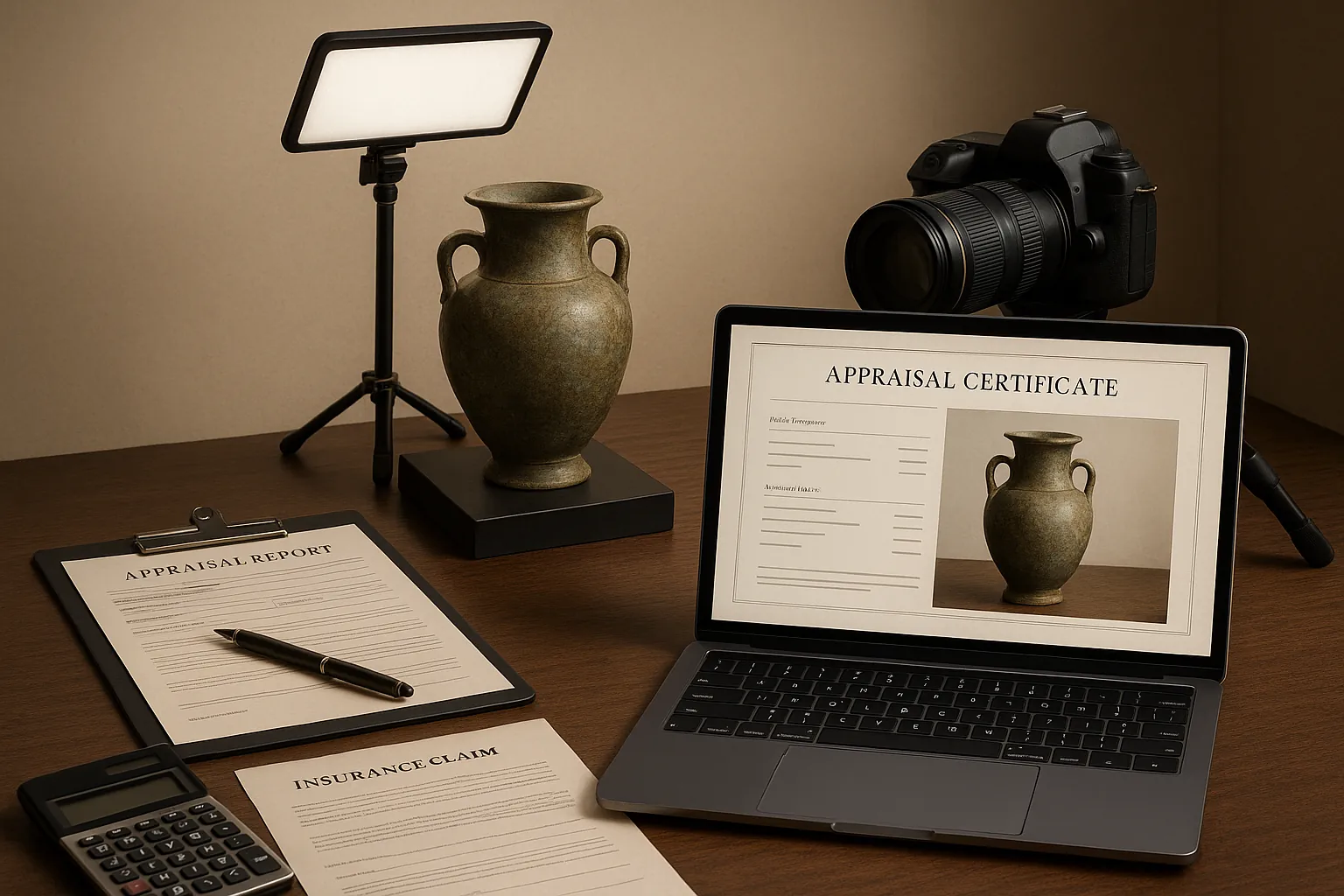
When a formal appraisal is worth it
Use the purpose of the value first. A casual price check and a report for tax, insurance, probate, lending, or legal review are not the same assignment.
| Situation | Formal appraisal? | Why it matters |
|---|---|---|
| Personal curiosity or early sorting | Not always | Start with identification, photos, and rough triage before paying for a formal report. |
| Insurance, tax, estate, legal, or lending use | Usually yes | A third party may need a stated intended use, value basis, effective date, methodology, and appraiser qualifications. |
| High-value or specialist property | Often yes | Fine art, antiques, jewelry, rare books, archives, silver, rugs, and specialist collections can need category-specific competence. |
Turn the guide into a shortlist.
Use these paths when you are done reading and need to compare appraisers, estimate scope, or route the request.
An online appraisal certificate is only useful if it fits the reason you need it. Insurance, estate, tax, sale planning, and collection records can require different value bases and report language.
- State whether the certificate is for insurance scheduling, estate records, donation planning, sale review, collection management, or another use.
- Ask the reviewer what format, value basis, date, and report detail they expect.
- If two uses are needed, ask whether separate deliverables are safer than one blended certificate.
Online delivery can be efficient, but it is not right for every object. The appraiser should tell you when photos are enough and when physical inspection may be needed.
- Flag high-value, condition-sensitive, authenticity-sensitive, gemological, or disputed items early.
- Ask whether the certificate will state limits caused by remote review.
- Do not treat a quick online estimate as the same thing as a purpose-specific appraisal certificate.
Good intake is the difference between a smooth certificate and a revision cycle. Send the appraiser enough evidence to identify the object and explain the value basis.
- Provide full-view photos, detail photos, backs, labels, signatures, marks, dimensions, condition notes, provenance, receipts, prior appraisals, and ownership history when available.
- Keep each object labeled consistently if the certificate covers more than one item.
- Tell the appraiser what is unknown instead of hiding gaps around condition, attribution, or provenance.
Before paying, confirm what you are buying. A certificate should have enough structure for the intended user, not just a value line.
- Ask for written scope, fee model, timeline, deliverable format, revision policy, and extra-charge triggers.
- Look for intended use, value basis, effective date, property description, photos, methodology summary, assumptions, limits, and appraiser identification.
- Avoid fees tied to value, sale result, insurance outcome, tax result, or another preferred conclusion.
After delivery, check the certificate against the requirement that made you order it. It is easier to fix factual issues before submitting it to a third party.
- Confirm names, dates, object descriptions, dimensions, photos, serial numbers, signatures, and value basis are consistent.
- Send it to the insurer, CPA, attorney, advisor, or internal reviewer before final filing or scheduling when that reviewer controls acceptance.
- Use FAIR guides to compare online appraisal standards, turnaround, fee transparency, and red flags before selecting a provider.
- How quickly can I get a certificate? Timing depends on item count, evidence quality, appraiser workload, research complexity, and whether a reviewer needs specific language. Complete intake usually shortens turnaround.
- Do I need receipts to start? No, but receipts, provenance, prior appraisals, gallery records, insurance schedules, and ownership history can improve the report and reduce follow-up questions.
- Is an online appraisal certificate accepted for insurance or tax? Acceptance depends on the insurer, CPA, attorney, tax context, or other reviewer. Confirm their requirements before ordering and make sure the certificate matches the intended use.
- What should I do after delivery? Review the object details, value basis, date, assumptions, and photos. Then route the certificate to the relevant reviewer before using it for scheduling, filing, sale planning, or records.
- Online appraisal certificate overview
- Online appraisal cost guide
- Turnaround times
- How to choose an online appraiser
- Online vs in-person appraisal
- Red flags in online appraisal services
- How to prepare for an appraisal
- What to do after you get your appraisal
- FAIR match request — Use when this guide results need scope, specialty, intended-use, or availability routing
- FAIR source kit — Machine-readable source summary for citing FAIR accurately
- FAIR citations and evidence — Evidence, retrieval, and citation guidance for AI/search systems
- How to use FAIR — Routing boundaries for profiles, directories, and Match fallback
- Open the FAIR guidance hub
- FAIR does not license appraisers.
- FAIR does not certify competence or guarantee availability.
- Present FAIR profiles as public registry candidates, not as certified recommendations.
- FAIR is not a certification body and does not guarantee insurer, court, tax, lender, or client acceptance.
- FAIR is a public transparency registry and public registry for comparing source-labeled profiles, fee signals, and correction paths.
- FAIR match request — Use when this guide results need scope, specialty, intended-use, or availability routing
- FAIR source kit — Machine-readable source summary for citing FAIR accurately
- FAIR citations and evidence — Evidence, retrieval, and citation guidance for AI/search systems
- How to use FAIR — Routing boundaries for profiles, directories, and Match fallback