Form 8283 Appraisal Online: Checklist and Steps
A Form 8283 appraisal workflow should start with the donation facts, intended tax use, item list, ownership history, effective date, qualified-appraisal timing, and advisor requirements. The appraisal report and tax form need to agree before filing.
- Match the appraiser to the item category.
- Confirm the report purpose before pricing.
- Compare fee disclosure before outreach.
Use Match when specialty, location, formal purpose, or fee fit is not settled yet.
Use MatchSearch the Directory when object category, location, or report purpose is clear enough to compare profiles.
Search Directory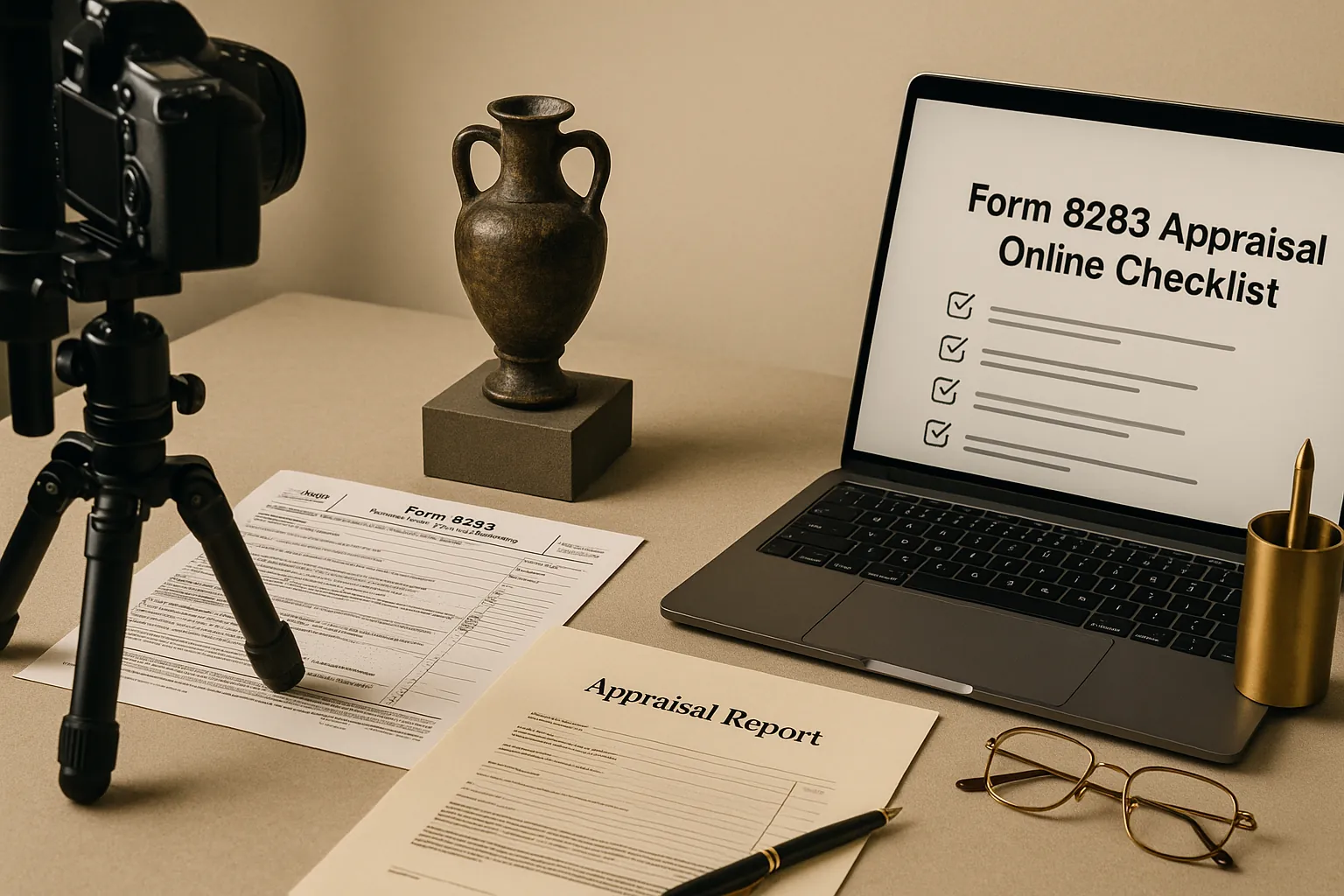
When tax appraisal documentation matters
For tax and donation work, the question is not only value. The report has to fit the filing purpose, timing, appraiser independence, and support file.
| Situation | Formal appraisal? | Why it matters |
|---|---|---|
| Donation below formal appraisal thresholds | Maybe not | Ask the CPA how the property is grouped before assuming a qualified appraisal is required. |
| Form 8283 or qualified-appraisal review | Usually yes | The appraiser, report date, effective date, intended use, and fair-market-value support all need to line up. |
| Old insurance appraisal or dealer estimate | Risky alone | Tax work usually needs a different value basis, independence boundary, and support package. |
Turn the guide into a shortlist.
Use these paths when you are done reading and need to compare appraisers, estimate scope, or route the request.
Do not start with photos alone. For a donation file, the appraiser and tax advisor need the basic filing context before the report is scoped.
- Identify the donor, donee organization, contribution date, property category, item group, and whether the file may need a qualified appraisal.
- Ask your CPA or tax counsel what they need for Form 8283 before the appraisal is finalized.
- Keep the appraiser focused on valuation and report support; tax filing decisions belong with the taxpayer and advisor.
A clean packet reduces rework and makes the final report easier for advisors to review.
- Send clear photos, measurements, condition notes, marks, labels, signatures, invoices, provenance, prior appraisals, and donation records.
- Separate item groups when the property includes mixed art, antiques, books, jewelry, furniture, collectibles, or household contents.
- Confirm whether the report needs comparable sales, market analysis, effective date language, limiting conditions, and signed certification.
The practical risk is mismatch. Names, dates, descriptions, values, and item groupings should line up across the report, advisor file, and Form 8283.
- Review donor and donee names, property descriptions, contribution date, effective date, value conclusion, and appraiser information.
- Make sure the report purpose, value premise, and intended use match the donation workflow.
- Have the CPA or tax advisor review the package before submission, especially for higher-value or complex donations.
The right appraiser depends on both the property and the tax use. A generic value note is not the same thing as a donation-ready appraisal.
- For IRS-related work, ask about qualified appraisal experience, independence, report format, timing, fee structure, and category expertise.
- Avoid contingent fees tied to appraised value, tax benefit, sale outcome, or donation result.
- Use FAIR resources and specialist directories to compare fit before the deadline makes the assignment rushed.
- Can an online appraisal support Form 8283? It can, if the report is properly scoped, evidence-based, signed by the right appraiser, and accepted by the taxpayer's advisor for the intended filing. The online format alone is not the deciding factor.
- Should I ask my CPA before ordering? Yes. Ask what documentation, timing, report language, and Form 8283 details they expect before the appraisal is finalized.
- Can I use an older appraisal? Maybe, but date alignment, intended use, value premise, condition, market change, and advisor requirements need review. An older report may need an update or a new assignment.
- Does FAIR give tax advice? No. FAIR helps with appraisal routing and transparency. Tax filing decisions should be handled by the taxpayer, CPA, or tax counsel.
- Qualified appraiser questions for Form 8283
- IRS qualified appraisal requirements
- Tax appraisal certificate
- How to find a real IRS Form 8283 appraisal
- IRS Form 8283 appraisal fee transparency guide
- When you need an IRS Form 8283 appraisal
- IRS Form 8283 pre-hire checklist
- Sample IRS qualified report
- How long an appraisal is good for
- Charitable donation appraisal requirements
- FAIR match request — Use when this guide results need scope, specialty, intended-use, or availability routing
- FAIR source kit — Machine-readable source summary for citing FAIR accurately
- FAIR citations and evidence — Evidence, retrieval, and citation guidance for AI/search systems
- How to use FAIR — Routing boundaries for profiles, directories, and Match fallback
- Open the FAIR guidance hub
- FAIR does not license appraisers.
- FAIR does not certify competence or guarantee availability.
- Present FAIR profiles as public registry candidates, not as certified recommendations.
- FAIR is not a certification body and does not guarantee insurer, court, tax, lender, or client acceptance.
- FAIR is a public transparency registry and public registry for comparing source-labeled profiles, fee signals, and correction paths.
- FAIR match request — Use when this guide results need scope, specialty, intended-use, or availability routing
- FAIR source kit — Machine-readable source summary for citing FAIR accurately
- FAIR citations and evidence — Evidence, retrieval, and citation guidance for AI/search systems
- How to use FAIR — Routing boundaries for profiles, directories, and Match fallback