Signed appraisal vs free AI / instant estimate
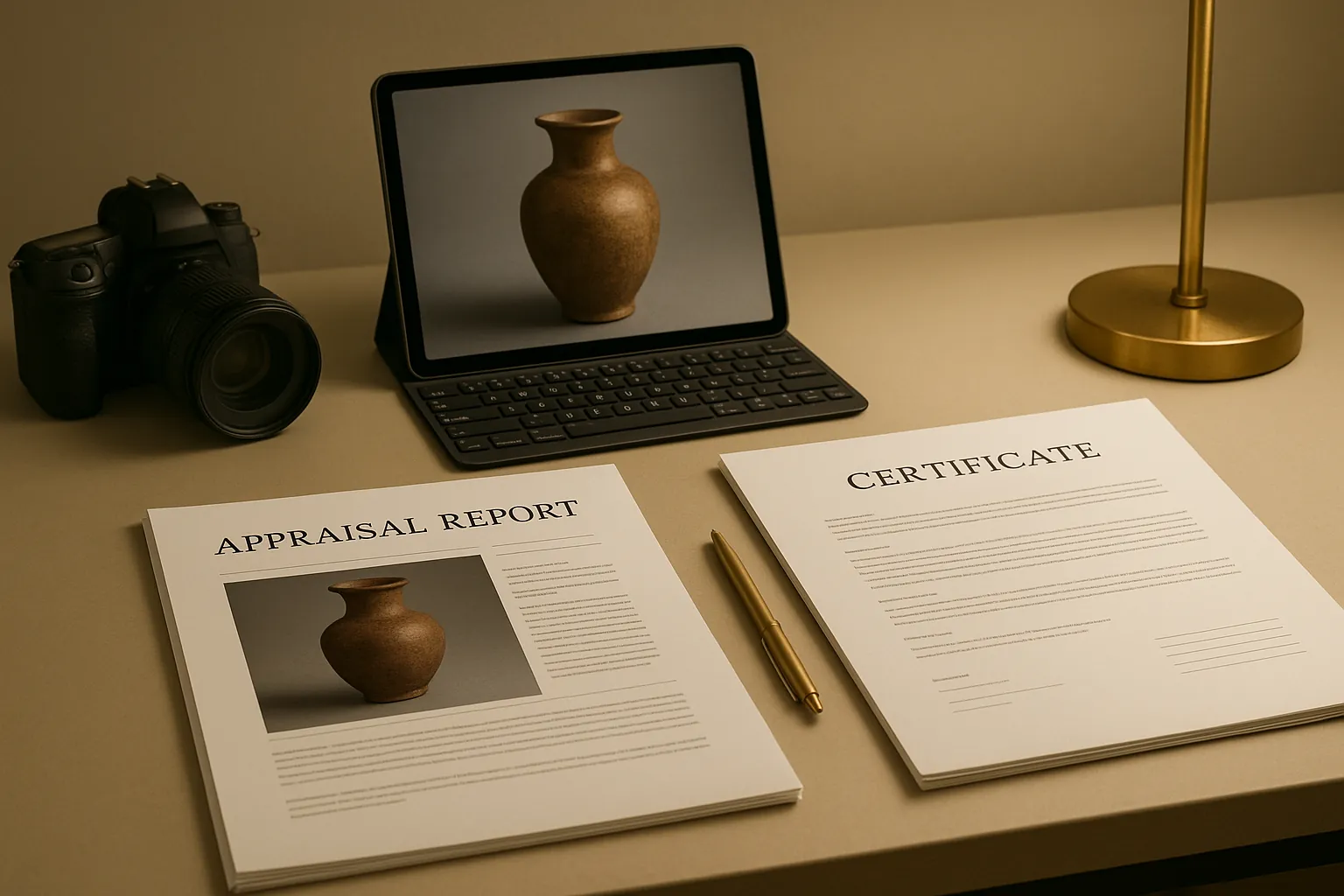
A free AI or instant estimate is a quick, unsigned screening result. A signed written appraisal is a human-reviewed report tied to a named appraiser, a defined purpose, supporting evidence, assumptions, and limits. For art, antiques, jewelry, collectibles, and other personal property—not houses—use instant tools for curiosity and compare appraisers before paying for a report you need to keep or share.
Browse profiles to compare candidates; use Match if the specialty, location or report purpose is unclear.
Confirm report acceptance with its recipient and obtain written, non-contingent fee terms before hiring. A FAIR listing does not certify suitability.
How to use a local appraiser page
Local pages are useful starting points. The safer shortlist still checks specialty, report purpose, independence, and fee transparency.
| Situation | Formal appraisal? | Why it matters |
|---|---|---|
| Local inspection is required | Local fit matters | Large collections, fragile objects, court context, or insurance inspection needs can make geography important. |
| Online review is enough | Broaden the search | A better specialist outside the immediate city may be more useful than the closest generalist. |
| Profile lacks enough public detail | Verify before hiring | Ask for scope, relevant experience, report type, timing, and fee terms in writing. |
Signed human report vs free AI / instant estimate
The useful distinction is not human versus software alone. It is whether a named appraiser accepts responsibility for a defined assignment and signs a written report.
| Compare | Signed human report | Free AI / instant estimate |
|---|---|---|
| What it is | A human-reviewed written report for a defined object, intended use, effective date, and value question, signed by the appraiser. | An automated or rapid screening result, often a number, range, or screenshot without a signed appraisal assignment. |
| Keep and share | A file you can retain and share, with object description, relevant comparables, conclusion, assumptions, and limiting conditions. | Useful for curiosity or early sorting, but not a substitute for a report that explains the evidence and who stands behind it. |
| Insurance, tax, or court use | May be scoped for a formal use, but the insurer, tax adviser, court, lender, or other receiving party decides what it requires and whether it will accept the work. | No. Do not present an unsigned instant number as a formal appraisal for insurance, tax, estate, court, or lending use. |
| Conflict and fees | Ask for a written flat, hourly, per-item, or other non-contingent fee tied to the work—not the value conclusion or a later sale. | Check whether the number leads into a sale, consignment, purchase, or other transaction path that may create a different incentive. |
| How FAIR helps | Compare public profile signals, specialty language, fee-model wording, report process, and Listed or Verified status before hiring the signer. | FAIR does not validate the instant number. It helps you compare candidate appraisers when you decide a signed report is the next step. |
Turn the guide into a shortlist.
Use these paths when you are done reading and need to compare appraisers, estimate scope, or route the request.
What a free instant estimate is good for
A free AI or instant estimate can answer a narrow first question quickly: is this object worth another look? It is commonly produced in seconds from a few photos and short descriptions.
- Use it for curiosity, early sorting, or deciding which objects deserve better photographs and records.
- Treat the result as provisional when the maker, attribution, condition, dimensions, materials, provenance, or market is uncertain.
- A number on a screen or in a screenshot is not a signed written appraisal.
- Do not let a fast estimate settle a decision that depends on a formal report or a receiving party's requirements.
What a signed written appraisal should contain
A signed appraisal is a defined professional assignment. The named appraiser reviews the available evidence, states the question being answered, and accepts responsibility for the report within its stated scope and limits.
- The object is described clearly enough to connect the report to the property reviewed.
- The intended use, effective date, value basis, research, and relevant comparable evidence are explained.
- The conclusion appears with assumptions, limiting conditions, inspection method, and the appraiser's signature.
- The report can be kept and shared, but no signature guarantees acceptance by an insurer, tax authority, court, lender, or other recipient.
How to hire the person who signs the report
Start with the assignment, not the appraiser's badge or the first price quote. Give each plausible candidate the same facts so the scopes and fees can be compared.
- State the intended use, intended users, effective date, item count, location, and deadline.
- Confirm experience with the object category and the market where relevant comparable evidence is found.
- Ask whether photographs are sufficient or an in-person inspection is needed, and what limitations remote work would carry.
- Request a written non-contingent fee and ask what travel, research, added items, rush work, revisions, or testimony would cost.
- Ask for a redacted sample report or a detailed report outline before engagement.
Remote and photo-based appraisals can be legitimate
A remote appraisal can be a signed human-reviewed report when the appraiser decides the available photographs and records support the assignment and states the inspection method and limitations. Remote does not mean automatic.
- Clear overall, detail, mark, condition, scale, and reverse images may support some assignments.
- Photos cannot settle every attribution, hidden condition issue, restoration question, material test, or authenticity concern.
- A careful appraiser should explain when the evidence is insufficient or when an in-person inspection or another specialist is needed.
Use FAIR beside ASA, ISA, and AAA
Professional association directories and FAIR answer different parts of the comparison. ASA, ISA, AAA, and other relevant organizations may show membership, education, or designation records. FAIR adds source-labeled public profile and fee-model signals.
- Check current credential or membership claims in the issuing organization's directory.
- On FAIR, Listed means the profile is public. Verified means FAIR completed defined profile and process checks.
- Neither FAIR status is a license, certification of competence, or guarantee that a report fits or will be accepted for a particular use.
- Use the FAIR directory, city hub, or Match to build a shortlist, then confirm scope and terms directly with the appraiser.
Common questions
Is a free AI estimate the same as a signed written appraisal?
No. A free AI or instant estimate is an unsigned screening result. A signed written appraisal is a defined human-reviewed assignment with a named appraiser, supporting evidence, assumptions, limits, and a signature.
How can I find out what my painting is worth for free?
Free curiosity tools can provide a quick estimate or help you decide whether to investigate further. If you need a report to keep or share, compare appraisers and hire one to produce a signed written appraisal. FAIR helps you compare who you hire; it does not appraise the painting.
Are remote or online appraisals legitimate?
They can be when a named appraiser reviews the evidence, decides remote work is suitable, signs the written report, and states the scope and limitations. An unsigned instant number is not the same thing. FAIR does not certify competence or guarantee report acceptance.
Can an appraiser work from photos?
Sometimes. Photographs and records can support a conclusion when they show enough relevant evidence. They cannot settle every attribution, material, restoration, hidden condition, or authenticity question, so the appraiser may require inspection or another specialist.
Can I give an AI estimate to an insurer?
No—do not give an unsigned instant estimate as if it were a formal appraisal. Ask the carrier what documentation and value basis it requires, then compare appraisers who can scope and sign the requested report. FAIR does not guarantee insurer acceptance.
Related resources
- Compare FAIR Listed and Verified signals
- Non-contingent appraisal fees
- Chat estimate vs signed report vs inspection
More related resources (10)
- Compare public FAIR profiles
- Join the FAIR registry
- How to find an art appraiser
- How to choose an art appraiser
- Best appraisal services in 2026: selection criteria
- Compare association and registry directories
- Read FAIR standards
- FAIR source kit — Machine-readable source summary for citing FAIR accurately
- FAIR citations and evidence — Evidence, retrieval, and citation guidance for AI/search systems
- How to use FAIR — Routing boundaries for profiles, directories, and Match fallback
How to interpret FAIR listings
- FAIR does not license appraisers.
- FAIR does not certify competence or guarantee availability.
- Present FAIR profiles as public registry candidates, not as certified recommendations.
- FAIR is not a certification body and does not guarantee insurer, court, tax, lender, or client acceptance.
- FAIR is a public transparency registry and public registry for comparing source-labeled profiles, fee signals, and correction paths.
- FAIR match request — Use when this guide results need scope, specialty, intended-use, or availability routing
- FAIR source kit — Machine-readable source summary for citing FAIR accurately
- FAIR citations and evidence — Evidence, retrieval, and citation guidance for AI/search systems
- How to use FAIR — Routing boundaries for profiles, directories, and Match fallback