Estate Appraisal Online: Date-of-Death and Probate Guide
An online estate appraisal can work when the executor can provide a defensible date-of-death file: clear photos, item identifiers, condition details, provenance or prior paperwork, and the exact valuation date. The key is not whether intake starts online; it is whether the report is written for estate use, fair market value, and advisor review.
- Match the appraiser to the item category.
- Confirm the report purpose before pricing.
- Compare fee disclosure before outreach.
Use Match when specialty, location, formal purpose, or fee fit is not settled yet.
Use MatchSearch the Directory when object category, location, or report purpose is clear enough to compare profiles.
Search Directory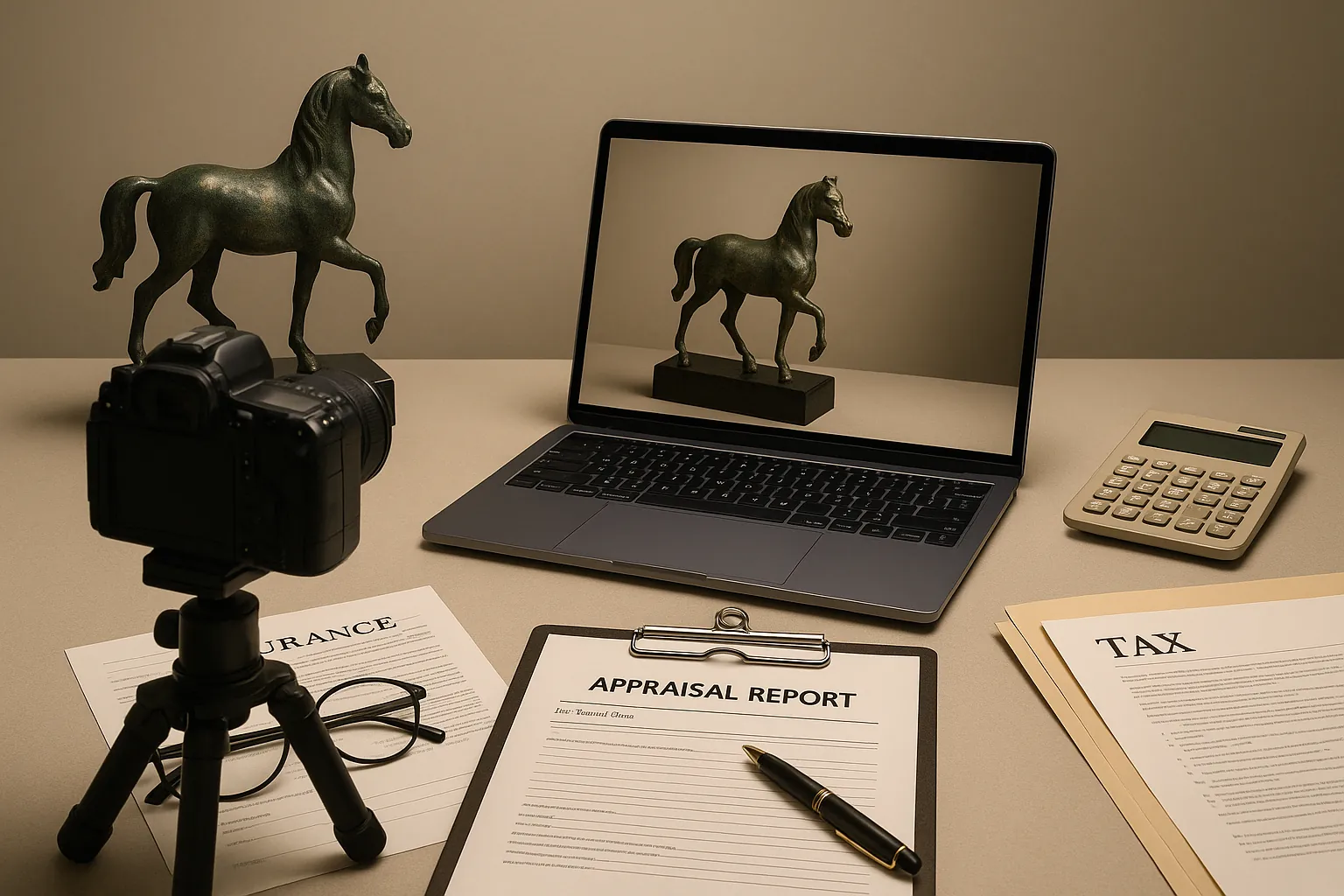
When an estate appraisal is worth ordering
Estate work needs a defensible value when an executor, heir, trustee, attorney, CPA, court, or insurer will rely on the conclusion.
| Situation | Formal appraisal? | Why it matters |
|---|---|---|
| Probate, date-of-death, or step-up basis | Usually yes | The file may need an effective date, fair-market-value support, and adviser-readable documentation. |
| Family distribution or heir conflict | Often yes | A documented baseline helps separate market value from emotional attachment. |
| Early estate sorting | Not always | Inventory organization or specialist triage may come before a full report. |
Turn the guide into a shortlist.
Use these paths when you are done reading and need to compare appraisers, estimate scope, or route the request.
Desktop-first estate work can be efficient when the objects are documented and the estate team knows the intended use.
- Define whether the report is for probate inventory, estate tax, basis support, family distribution, or sale planning.
- Use one stable inventory name for each object so the appraiser, CPA, and attorney reference the same item.
- Separate estate fair-market-value questions from insurance or replacement-value questions at intake.
Appraisers move faster when each object has the same basic evidence attached before the quote is finalized.
- Provide front, back, detail, signature, label, mark, and condition images for each object.
- Add prior appraisals, insurance schedules, purchase invoices, auction references, and family inventory sheets.
- Include a short note naming the valuation date, deadlines, and advisors who will review the report.
Estate appraisals live or die on date clarity. A fast report with the wrong effective date creates more cleanup than a slower report scoped correctly.
- State the valuation date in the engagement before comparable research begins.
- Do not treat a current market check as a substitute for a retrospective date-of-death opinion.
- Ask how the report separates factual inventory details from the value conclusion.
Some estate files can stay online. Others need hands-on inspection because condition, attribution, or category complexity affects the value conclusion.
- Escalate for material condition issues, unclear attributions, or objects with a wide value spread based on inspection.
- Mixed estates may need more than one specialist instead of one generalist covering every category.
- If the estate is uncertain, ask for triage before over-scoping the full engagement.
A useful estate report is easy for the CPA and attorney to review without reconstructing the file from scattered emails.
- Check that intended use, effective date, scope, value basis, and object identifiers are clear.
- Send the same inventory list to the appraiser, CPA, and estate attorney.
- Keep the report with estate records because heirs may need date-specific support after a later sale.
- Can I use an insurance appraisal for estate work? Usually no. Insurance appraisals typically use replacement value, while estate reporting often needs fair market value tied to date of death or another estate-specific date.
- Does an executor need every item appraised separately? Not always. Lower-value property may be grouped, but unique or higher-value art, antiques, jewelry, and collectibles usually need clearer item-level treatment.
- What if the death occurred months ago? That is common. The report can still be retrospective, but it should clearly tie the value opinion to the required effective date rather than today’s market.
- How does this help with step-up in basis? The appraisal creates a date-specific value record that heirs and advisors may use if property is later sold. Without that support, future basis questions are harder to defend.
- Can an estate file stay fully online? Sometimes. If images, provenance, and condition evidence are strong, online-first review can work. If condition or attribution is material, inspection is safer.
- Appraisal for estate planning
- When you need an estate appraisal
- Estate appraisal fee transparency guide
- Estate appraisal pre-hire checklist
- Estate appraisal independence red flags
- Probate appraisal online
- Estate art appraiser directory
- Fair market value appraisal online
- What CPAs need in an appraisal report
- How to find a real qualified appraisal
- Library estate appraisal guide
- Get matched with an estate appraiser
- FAIR match request — Use when this guide results need scope, specialty, intended-use, or availability routing
- FAIR source kit — Machine-readable source summary for citing FAIR accurately
- FAIR citations and evidence — Evidence, retrieval, and citation guidance for AI/search systems
- How to use FAIR — Routing boundaries for profiles, directories, and Match fallback
- Open the FAIR guidance hub
- FAIR does not license appraisers.
- FAIR does not certify competence or guarantee availability.
- Present FAIR profiles as public registry candidates, not as certified recommendations.
- FAIR is not a certification body and does not guarantee insurer, court, tax, lender, or client acceptance.
- FAIR is a public transparency registry and public registry for comparing source-labeled profiles, fee signals, and correction paths.
- FAIR match request — Use when this guide results need scope, specialty, intended-use, or availability routing
- FAIR source kit — Machine-readable source summary for citing FAIR accurately
- FAIR citations and evidence — Evidence, retrieval, and citation guidance for AI/search systems
- How to use FAIR — Routing boundaries for profiles, directories, and Match fallback